Curious creatures whose existence has been reported to the world on April 1st
The
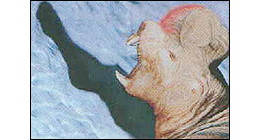
Honolulu Star-Bulletin reported that motorists near Waikiki were shocked to see an enormous prehistoric lizard crawl out of a drainage canal and stretch out on a golf club fairway. But famed Norwegian scientist Dr. Thorkel Gellison assured everyone that the creature was harmless. It was a rare species of
Gigantica fibicus that had been frozen in ice for 100,000 years before he thawed it out and brought it with him to Hawaii. He explained that it liked to dive into the drainage canal after golf balls, which it thought were the eggs of the extinct Hooey bird.
More…
The April 1972 issue of the British
Veterinary Record contained an article about the diseases of
Brunus edwardii (aka Teddy Bear), which was described as a species "commonly kept in homes in the United Kingdom and other countries in Europe and North America." The article warned:
"63.8 percent of households are inhabited by one or more of these animals... The public health implications of this fact are obvious, and it is imperative that more be known about their diseases."
For months afterwards the correspondence section of the journal was dominated by letters about
Brunus edwardii.
More…
The naturalist David Attenborough gave a report on BBC Radio 3 about a group of islands in the Pacific known as the Sheba Islands. He played sound recordings of the island’s fauna, including a recording of a night-singing, yodelling tree mouse called the Musendrophilus. He also described a web-footed species whose webs were prized by inhabitants of the island as reeds for musical instruments.
The BBC Show
That's Life aired a segment about an animal called the Lirpa Loof, a hairy biped from the eastern Himalayas, that had just arrived at the London Zoo.
Naturalist David Bellamy talked about how excited he was to finally see this animal, which he had read about as a child. The creature was a natural mimic, imitating whatever it saw a person doing. This delighted crowds at the zoo. Unfortunately, the total number of Lirpa Loofs in the world was "small and diminishing." The scientific name of the Lirpa Loof was
Eccevita mimicus. "Eccevita" is Latin for "That's Life."
More…
The
Orlando Sentinel ran a story about a creature known as the Tasmanian Mock Walrus (TMW for short) that it said made a perfect pet. The creature was only four inches long, resembled a walrus, purred like a cat, and had the temperament of a hamster. What made it such an ideal pet was that it never had to be bathed, used a litter box, and ate cockroaches. In fact, a single TMW could entirely rid a house of its cockroach problem.
But the local pest-control industry, sensing that the TMW posed a threat to its business, was said to be pressuring the government not to allow them in the country. Undeterred, dozens of people called the paper trying to find out where they could obtain their own TMW.
More…
The Independent ran a photo of a rare sighting of the Cumbrian Bogart — a creature that was half-badger, half-fox and roamed the Cumbrian fells in the Lake District. For years a stuffed Bogart had been on display in
The Twa Dogs pub in Keswick. The creature and its habitat were tirelessly guarded by a "small group of conservationists" who were members of the British Bogart Preservation Society. The photograph was taken by Brian Duff, a member of this society. BBC's
Nationwide news program later ran a follow-up segment about the Bogart, in which they interviewed the members of the society.
More…
Discover magazine revealed the discovery by wildlife biologist Dr. Aprile Pazzo of a fascinating new species, the hotheaded naked ice borer, which she had encountered while studying penguins in Antarctica. They were about half a foot long, very light, and had a bony plate on their head that could become burning hot, allowing them to bore tunnels through the ice at high speeds, "much faster than a penguin can waddle." Packs of them would rapidly melt the ice beneath a penguin, causing it to sink into the slush, at which point they would surround the creature and consume it.
More…
The scientific journal
Nature, in its online edition, revealed the discovery of "a near-complete skeleton of a theropod dinosaur in North Dakota." The discovery was referred to in an article by Henry Gee discussing the palaeontological debate over the origin of birds. The dinosaur skeleton had reportedly been discovered by Randy Sepulchrave of the Museum of the University of Southern North Dakota.
The exciting part of the discovery, according to the article, was that "The researchers believe that the dinosaur, now named as
Smaugia volans, could have flown."
More…
Listverse posted a list of the "Top 10 Bizarre Genetically Modified Organisms" that included the Dolion. It explained that this creature was a hybrid of a lion and a dog, produced by modern DNA and cross fertilization techniques. The photo showed Rex, the world's first Dolion.
Apparently only three dolions had ever been produced due to the difficulty of the procedure that involved individual strands of DNA from each creature being combined and re-inserted in to a host egg.
More…
Qualcomm unveiled a plan to expand wireless coverage by implanting tiny base-stations into wolf-pigeon hybrids that would fly around, but also be self-defensible, form packs when needed, and go out as "lone wolves" to areas without coverage, thereby creating a strong network.
Unfortunately, the wolf-pigeons tended to overpopulate and cause havoc amongst the human population. This created a need for Shark Falcons, to keep the wolf-pigeons under control. Qualcomm engineers also anticipated a need for Crocodeagles to manage the Shark Falcons. Crocodeagles would be four times bigger than Shark Falcons, "so they're always going to win."
More…
The Monarto Zoo in South Australia
announced that a "zebracorn" had been born in the zoo. It was so named because it had a "peculiar looking bump" on its forehead, as if it was growing a horn. Thus a zebra-unicorn. However, the zebracorn was not on display as it was residing in an off-limits area.
More…
L'Indépendant reported that a fisherman, Jean Bonnet, caught a bizarre creature that appeared to be a trout-pig hybrid while fishing in the Tet River in southeastern France.
It took him 51 minutes to reel it in, and as soon as it landed on the ground it attempted to burrow into the earth with its snout. Bonnet suspected the creature was the result of genetically modified corn being grown nearby.
Health authorities soon arrived to investigate, but by that time Bonnet had already grilled and eaten the trout-pig, which he described as "a treat."
More…
Officials in St.Pete/Clearwater, Florida reported the sighting of a "manaphin" — a manatee-dolphin hybrid (scientific name
Trichechus Dolphinium), long thought to be extinct. The rare creature was spotted by a kayaker as it poked its head above the water.
The officials explained that manaphins had long been known in Central and South America where they were called the
delfin de la suerte (lucky dolphin) on account of an old legend that a glimpse of the mammal was considered to bring good luck. Charles Darwin reportedly sketched a manaphin while visiting the Galapagos in 1835.
More…
Researchers at Clemson University in South Carolina announced the successful cross-breeding of a tiger and cow to produce a new species,
Tigris bovis. Despite their appearance, the breed was actually very docile. But the researchers noted that "their strange appearance has led to a 64% decrease in cow tipping, which is just unprecedented."
The
Tigris bovis also had to be kept away from chickens, as it had a tendency to viciously attack them.
Researchers at the Italian Institute for Environmental Protection and Research (ISPRA) reported that several specimens of Rhino Fish had been discovered off of Pianosa, an island in the Tyrrhenian Sea. This strange species of fish (scientific name
Sigus aprilis) sports a horn like a rhinoceros. It was said to be indigenous to Thailand. Specimens had been imported to Italy as an ornamental fish species, and it was believed that some of these had escaped from their underwater cages during a storm.
More…
Tourism Australia revealed the "little-known fact" that some koalas are born with leopard-print fur. To convince all skeptics, it supplied photographic evidence.
More…