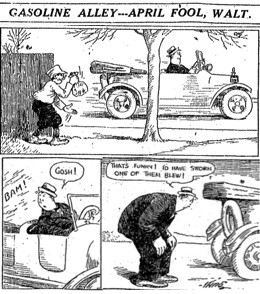
Amos McKeand of Oakland, California was about to go home when he discovered that someone had replaced the front wheel of his motorcycle with a wheel from a baby carriage. Suspecting it was his colleague, R.W. Moore, he decided to retaliate by removing the generator from Moore's machine. While doing this, he was arrested by a patrolman and taken to jail. He appeared the next morning in police court and announced that he was off practical jokes forever. [
Oakland Tribune, Apr 2, 1920.]
More…
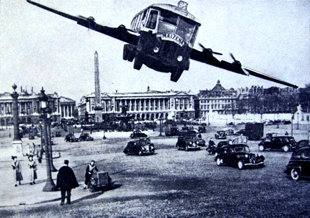
International Soundphoto distributed a photo of a flying bus swooping over the Place de la Concorde in Paris, France. The photo ran in many papers, accompanied by the caption: "Well, Well, look how all those Parisians are being missed by the bus at Place de la Concorde. Anything can happen in the French capital on April Fool's day, they say, but it is suspected that some zany darkroom jokester had something to do with this." [
Newsweek - Apr 10, 1950.]
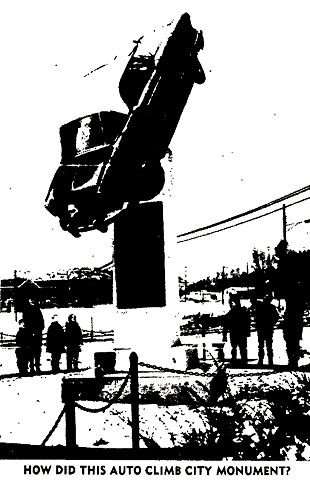
Under cover of darkness, anonymous pranksters managed to balance a car on top of the War Memorial in Connellsville, PA (at the intersection of Route 119 and North Pittsburgh St.). City authorities were searching for those responsible, as well as for "a boom large enough to remove the vehicle." Children enroute to school first noticed the car on the monument.
More…
Emil Seligo of Los Angeles is shown waiting for his 17-year-old son Paul to return from his high school classes. Emil had forgotten that Wednesday was April Fool's Day, but Paul hadn't, and he and a friend somehow managed to get the family's small imported car into the middle of the living room while the rest of the family was asleep.
More…
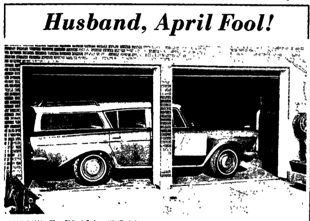
This is the sight Richard Carlson of Palatine, Illinois was greeted by when he came home. The car was sideways in the garage with the sign "April Fool!" hanging on it. His wife was the culprit. She told him it was payback for teasing her about being too afraid of the garage's center post when she pulled the car in. She proved she wasn't.
More…
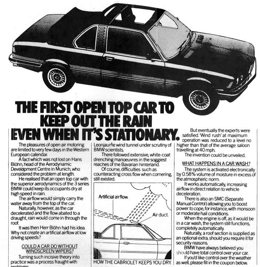
BMW revealed that one of its engineers, Herr Blöhn, had developed a sunroof that could be kept open even in the rain, thanks to jets of air that blasted the water away from the top of the car. The system worked completely automatically, even in a car wash.
Those seeking more information were directed to query "Miss April Wurst" in the BMW marketing department.
More…
The Sunday Times revealed that London Transport soon planned to start using driverless buses within the city. The buses would follow a magnetic track while cameras scanned the road, relaying images back to a controller at headquarters who could switch the vehicle to manual drive and steer it out of trouble, should that be required.
LT hoped the plan would prove a "dynamic money-winner." Although a public opinion poll conducted for the Sunday Times noted 100% public opposition to the plan.
More…
BMW announced that its Chief development engineer, Herr Brehn, had come up with a solution for the "irksome chore" of maintaining correct tire pressure: dashboard tire pressure control:
"Herr Brehn perfected a revolving seal, kept airtight by an ingenious contra-flow of air under very high pressure...
Touch a button on the console and a digital display gives pressure... A compressor feeds air into storage units. It then travels to the wheel centre via the revolving seal and through to the tyre. Excess pressure is merely vented into the contra-flow system."
More…
Byte magazine featured a new portable computer, available from the Honda Corporation, called the "Transporter":
"The first truly transportable computer. With a few simple twists, you can transform the Transporter from a portable computer (with full keyboard, 24-line by 80-column display, and two microfloppy-disk drives) into a single-passenger automobile... The Transporter is 100 percent compatible with the popular Toyota Corolla and runs on most operating roads."
Byte later received a call from a
USA Today reporter inquiring about the Transporter.
More…
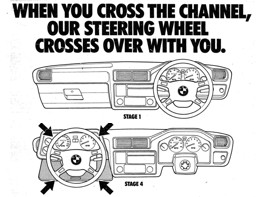
BMW announced that its engineer Aap Rilfühl had figured out a way to allow drivers to switch the position of their steering wheel, so that British drivers could move the wheel whenever they crossed the channel from Britain to France:
By incorporating a second-unit steering wheel socket and instrument panel into a conventional glove compartment, Dr. Rilfühl was able to provide the basis for a secondary driving position.
More…
A Yorkshire ad agency, Male Winram Tweddle and Associates, placed an ad in the
Yorkshire Post describing a new super-car, the Clegg GTi Turbo. The ad claimed that compared to this car "Owt else is nobbut middlin". A phone number was also provided for those wanting more information. When people called this number they were informed that they had "bin 'ad by some poncey ad agency."
More…
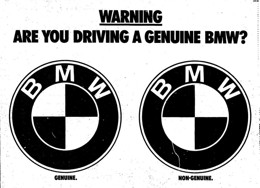
BMW ran an ad in the
London Times warning that a Far East company specializing in "reproduction cars" was selling fake BMWs in the UK. The company offered tips for drivers to determine if their BMW was real or a forgery, such as checking the roundel to make sure it matched the "genuine" symbol.
More…
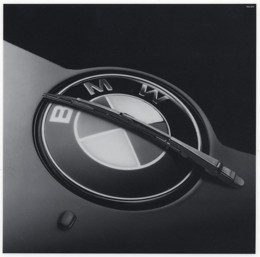
BMW announced a new technological innovation that would be incorporated into future versions of its cars—the badgewash system. No longer would BMW drivers have to endure dirt on their enamel bonnet badge:
"A tiny sensor mounted in the wiper arm measures the light reflected back from the white sections of the BMW badge… Even if a film of dirt cuts out as little as 5% of that light, the sensor will detect it and start the wiper."
More…
BMW unveiled a "significant advance in anti-theft technology" — Driver's Weight Sensors:
"DWS stands for Driver's Weight Sensor. A unique system that compares the driver's weight with a pre-programmed value stored in the sensor's computer memory...
The sensor weight reading is then compared to the programmed weight in the memory, and provided this falls to within ±5%, the car will start normally.
If, however, the figure exceeds these tolerances, then a discreet gong sounds, and the entire ignition system is shut down."
Interested readers were urged to contact Hugh Phelfrett at BMW.
More…
BMW Canada ran an ad in the
Globe and Mail announcing a new addition to its luxury cars: road warmers. Pivoting convex lasers mounted in front of each wheel would melt ice and snow on the road as the car was being driven. Turbo fans would then remove excess moisture from the road. According to BMW's press release, this invention would "virtually eliminate the need to clear your driveway during winter." The advertisement assured readers that road warmers would eventually become standard on all new BMWs, but until then dealers would install them on older models free of charge.
More…
The Hoffman York & Compton ad agency released promotional material introducing the Caballo XL, a revolutionary new South American car built around 'five-wheel drive' technology. This involved a "unique shock absorbing system" that would allow drivers to go at speeds in excess of 160 mph over rough, bumpy roads. The small firm later explained it issued the release in order to drum up business from the car industry by showing that it could "play in the big leagues".
More…
Volkswagen ran an ad in the
London Times promoting a car featuring a "decomposable roofrack." The tagline read, "It's not an April fool. It's a Volkswagen."
More…
A commercial for BMW aired on British TV promoting a revolutionary new technology, "anti-track control," that enabled the removal of tire tracks from the ground. The ad explained that the technology had been developed by East German military authorities, but it could now be used by surreptitious lovers seeking to conceal their tracks from suspicious partners. The spoof commercial was created for BMW by ad agency WCRS. The footage of disappearing tire tracks was created by taking a previous BMW commercial and playing it backwards.
More…
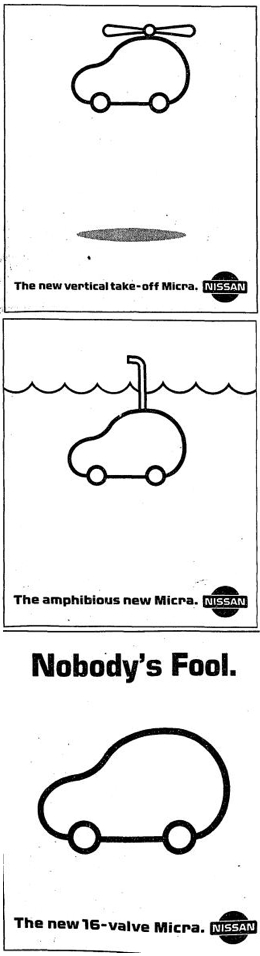
Ad for the Nissan Micra that ran in the
London Times - Apr 1, 1993.
More…
BMW announced that certain models of their cars would be fitted with "Optiglass" — a new optical technology that eliminated the need for drivers to wear glasses:
"80,000 transparent threads of silicon are coated onto a Polyvinylbhytral layer (PVB in English) to conduct a charge throughout the focal area of the screen — in much the same way as demisting systems work.
By varying the temperature of the PVB with a simple flick of the dashboard-mounted switch, the refractive index of the glass changes, creating a lens to suit the requirements of all drivers."
More…
BMW announced that it would be adding a new feature to its entire line of cars: an Insect Deflector Screen (or IDS for short), designed to keep windscreens bug free. The IDS, developed by Munich scientist Dr. Jurgen Afalfurit, consisted of a clear rubber coating applied to the windscreen. The coating itself was invisible to the eye, but it caused bugs to literally bounce off the window, "even at high speeds."
Drivers were invited to find out more about IDS by filling out a coupon and checking one of the following options: "I find flies get stuck to my windscreen -- Hardly ever; Sometimes; Far too Often."
More…
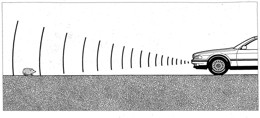
BMW announced a new feature for its cars — WAIL, which stood for "Wildlife Acoustic Information Link." It was a device designed to prevent animals from becoming roadkill by emitting high-pitched soundwaves (inaudible to human ears, but audible to animals) that sent critters scurrying out of the way:
"This operates on the same ultrasonic echo-sounding principle as BMW's Park Distance Control System. Sonic waves are emitted from the front bumper producing a warning call which alerts stray animals to the approaching car. This then encourages them to jump in the nearest hedgerow."
More…
BMW unveiled new "Klimatarbeiter" technology, that could create a range of air conditioning ambiences inside of a car, including "Bavarian Mountain Medley," "New England Fall," "Bessarabian Breeze," or "English Summer." The technology was the brainchild of Dr. Heidi Luftkopf of BMW's Stenchnicht research facility in the Bavarian Mountains.
More…
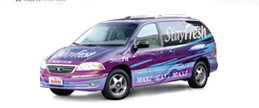
Esquire introduced its readers to an exciting new company called Freewheelz in an article titled "There Are No Free Wheels." Freewheelz planned to provide drivers with free cars. In exchange, the drivers had to place large advertisements on the outside of their vehicle (such as ads for StayFresh Maxi Pads). Ads would also play constantly on the radio inside the car. Prospective drivers had to go through a screening process, requiring them to submit stool samples and notarized video-store-rental receipts.
The article satirized the much-touted "new economy" created by the internet. Readers who didn't realize this barraged
Esquire with phone calls, wanting to know how they could sign up to drive a StayFresh minivan.
More…
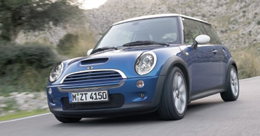
Car-maker MINI placed ads in several Australian papers describing a new space-saving technology: the Vertical Parking Locator (VPL), which allowed MINIs to park vertically on the side of buildings:
"ASC+T-backed VPL gives MINIs sufficient traction to attain and maintain an erect parking position and to cling securely to the side of the designated building. All-but seamless in operation, VPL makes its presence felt via a subtle frisson of vibration as the traction system is activated. A warning jingle recorded by a string quartet in the key of G also sounds."
More…
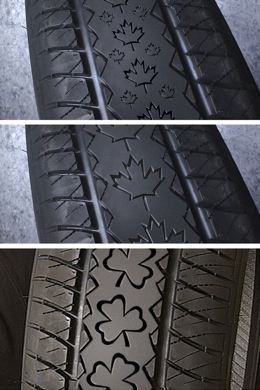
Dunlop Tires announced the introduction of personalized tire treads:
"For hundreds of years people have been monogramming their clothes, and there's certainly no shortage of personalized license plates, so why shouldn't they be able to add a personal touch to their tires too?' said Ian McIntosh, General Manager of Advertising & Marketing Services, Dunlop Tires (Canada)...
Dunlop Ident-a-Treds are the product of more than a decade of top-secret work at the company's remote Canadian research and development facility in Serit Polnud, NWT. Researchers at the Serit Polnud lab created the new, ultra malleable and highly adhesive tires by combining sticky sap from Canadian maple trees with traditional rubber compounds. Dunlop Ident-a-Tred tires are available with initials, symbols, designs or logos engraved onto the tire treads, combining superior traction and handling with unique style."
More…
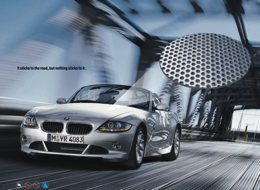
BMW Canada announced that its engineers had developed a system that used "microscopic blowholes" in the surface of the car, blowing away "dust, bugs, water and everything else," and thereby keeping the car constantly clean. BMW owners would never have to wash their car again!
[This was one of four April Fool ads run by BMW Canada in 2004.]
More…
BMW ran an ad in the
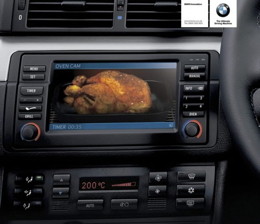
Guardian unveiling its new Satellite Hypersensitive Electromagnetic Foodration (SHEF) Technology, which allowed drivers to cook their dinners from their car as they drove home from work. All the dials for the home oven were built into the dashboard of the car and communicated wirelessly with the actual oven at home. Drivers could monitor the progress of their meal via a built-in oven-cam. The ad directed readers to a website that offered recipes such as "chicken a la M42."
More…
BMW warned that by the end of 2007 right-hand drive cars would be banned throughout mainland Europe. In response, their engineers had developed "hands-free steering" that used "a combination of sensors and VAT (Voice Activated Technology)" in order to do away with the steering wheel. "All the dials and controls are mounted in the centre of the dash on a pivoting section which can be angled towards either of the front seats..."
However, it cautioned:
"Early prototypes were prone to sudden U-turns if the driver swung round to shout at the children in the back."
More…
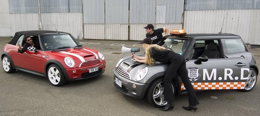
MINI Australia warned drivers of the MINI Cabrio that a detail of their contract specified that they always had to keep the roof of their car open, even during inclement weather. Failure to honor this contract would meet with severe punishment. The driver would be "ejected from their vehicle" and their car would be given to someone "willing to comply with the Contract."
A team of specially trained MINI operatives, the MINI Roof Down Squad (M.R.D.S.), took to the streets of major Australian cities on April 1st in order to detect violations of the MINI Always Open Contract.
More…
MINI USA debuted a special new model of its car, the "MINI Pullman," adapted to ride on domestic gauge rail lines throughout North America:
"In conjunction with the North American railway system, an exclusive right-of-way has been authorized for the specially equipped MINI to commute via rail during peak hours in major urban centers... The MINI Pullman comes fitted with a special wheel package that easily locks onto standard gauge rail thus allowing MINIs to corner on the roads and the rails with equal aplomb. An upgraded dual air-horn warning system comes standard on the model to alert inattentive pedestrians and vehicles as the MINI Pullman enters into crossing gate areas."
More…
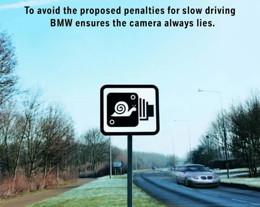
BMW warned that "Slow Cameras" would soon be installed on British roads to photograph drivers going more than 20 mph below the speed limit. In response, BMW engineers had developed "ZIP" (Zoom Impression Pixels):
ZIP is a pixel-based coating that covers the entire exterior of the car. If you are travelling below the speed limit in range of a Slow Camera, sensors around the car detect the camera and the pixels immediately become blurred. This gives the impression of higher velocity and the Slow Camera is fooled into thinking the car is travelling at the correct speed.
More…
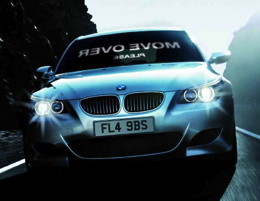
BMW unveiled new technology that allowed drivers to communicate messages via their windscreens:
The system uses Reactive User Sound Electronic (RUSE) particles which are embedded in the windscreen. All the driver has to do is say what's on their mind and the RUSE particles react to their voice to translate their words into an instant message. It enables BMW drivers to communicate advice, warnings, helpful driving tips and salutations to other road users without even lifting a finger.
More…
Motive magazine ran an article about a new program from Lamborghini allowing owners to pick specific cows with which to outfit their cars' leather interior.
More…
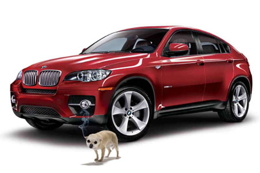
BMW unveiled Canine Repellent Alloy Protection:
The brainchild of Dr. Hans Zoff, head of automotive security, it prevents any dog from relieving itself on the car by administering an immediate, and relatively painfree, electric shock. But the real surprise is that the 220 volts required for this, come courtesy of our brake energy regeneration system. This converts energy created under braking into an electrical charge known as Rim Impulse Power (R.I.P.) and stores it ready for the next encounter.
More…
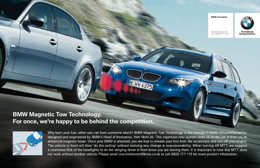
BMW unveiled "Magnetic Tow Technology."
"The unique system, developed in conjunction with NASA, works via a discreet unit located in the front valance that projects an enhanced magnetic beam 20 metres in front of the BMW. Once a suitable target car is located and the BMW is magnetically locked on behind it, the driver is then able to take his foot off the accelerator, turn off the engine and let the car in front do all the work. The towing car will not notice any change in manoeuvrability."
More…
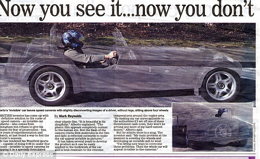
The
Daily Express reported that a British inventor had built an invisible car, designed to fool speed cameras:
"It is beautiful in its simplicity... The plastic film appears completely normal to the human eye. But the flash of the camera reacts with molecules in the film and light is reflected outwards to make the car appear invisible in pictures."
The inventor admitted that the one problem was also covering the wheels and developing an invisible suit to wear.
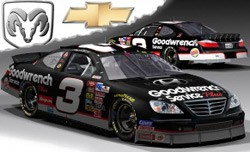
Car and Driver Magazine revealed that the White House had ordered GM and Chrysler to stop participating in NASCAR by the end of the 2009 season, deeming it an "unnecessary expenditure." Failure to comply would disqualify them from receiving any additional bailout money from the government.
NASCAR was said to be exploring other options, such as inviting Korea's Hyundai corporation to compete in GM and Chrysler's place.
More…
The Moscow Times revealed details of the new limousine used to transport President Dmitry Medvedev. It was said to be far more secure than "The Beast" (the nickname of the limousine used to transport U.S. President Obama).
"The Russian car has a 12-centimeter-thick titanium plated roof that is so strong a T-72 tank can drive over it without causing any real damage... Its windows are made of glass that will withstand a direct hit from a rocket-propelled grenade, while its wheels automatically turn into caterpillar tracks when going over rough terrain...
The Kremlin official noted that the car's occupants could survive a small nuclear attack, but only if the wind was blowing in a certain direction."
A number of news outlets reported the story as fact, including
The Guardian.
Der Spiegel and three media outlets in South Korea contacted
The Moscow Times seeking more details.
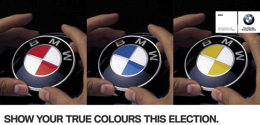
BMW revealed that, in the spirit of the upcoming UK elections, it had created a way for BMW owners to display their political leanings by changing the color of their hood roundel to match the color of their favorite political party. The "Political Roundel Attachment Tag" (PRAT) would be available in the colors of all major UK parties.
Should the car owner decide to switch political allegiances, the roundel tag could be replaced in a matter of seconds.
More…
The UK company Auto Windscreens launched what they claimed was the "first prescription windscreen."
"Researching the curvature of corrective spectacles for myopia (short sightedness) led Auto Windscreens to successfully develop a windscreen which can be curved to match an individual's ophthalmic prescription. The resulting prescription windscreen will ensure that UK drivers will never have to be frustrated with finding their glasses or, more importantly, risk driving illegally without them."
More…
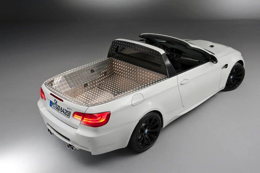
BMW unveiled a pickup-truck version of its M3 sportscar at a Munich auto show. It boasted that it was, by far, the "sportiest" as well as fastest pickup truck available, and that it would "fire the imaginations of all motorists with a deep appreciation of top performance matched by a keen practical bent."
The M3 pickup was actually quite real, functional, and street legal. However, it was a one-off and was not heading for mass production. BMW revealed that it would use the car as a transport vehicle in its workshops.
More…
Land Rover noted that new legislation required that a vehicle's tax disc "must be displayed within parameters that do not exceed 10 degrees". This legislation had been introduced because of Traffic Enforcement officers who were suffering from Repetitive Neck Strain (RNS) from looking at sharply angled tax discs all day.
In order to make sure all Land Rover owners complied with the law, Land Rover had developed a "self-levelling tax disc holder" that always kept the tax disc at the legally required angle. The holder employed "Contra-Motion technology" to achieve this.
More…
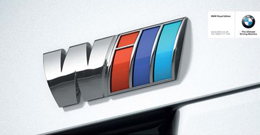
BMW ran ads in UK newspapers announcing that in honor of the forthcoming wedding of Prince William and Kate Middleton, a special "Royal Edition" of the BMW M3 Couple would be available for one month. It would come in three colors: Regal Red, Bridal White and Imperial Blue.
It would also be adorned with a commemorative "Will" emblem.
More…
BMW debuted a "driverless Running Coach" feature that transformed the car into a fitness coach. Cars fitted with this technology would be able to drive themselves, while following behind the jogging owner.
Exterior speakers would play encouraging words to keep the runner motivated, while the "Lock Out Logistics" feature would prevent the jogger from getting into the car until he had completed his full run.
More…
Peugeot announced that the Peugeot RCZ would be the first car to come with "mood paint." This paint consisted of a "specially developed psychochromatic coating" that altered its molecular structure to emit light at varying wavelenghts — "literally changing the color of the car to reflect how you're feeling."
More…
Honda introduced the HondaHAIR™, the world's first in-vehicle haircutting accessory, promised to be a feature in the 2014 Honda Odyssey. Honda elaborated:
"Our philosophy is to imagine mobility in areas once thought immobile... Getting a trim is typically thought of as a location-based activity that requires a special trip to your hairstylist or barber, but that's where the HondaHAIR comes in. It's simple, efficient, and it's an enjoyable way to cut hair on the go. Using the HondaVAC in the 2014 Odyssey simply attach the hair-cutting tool to the nozzle, then let the powerful suction of the HondaVAC take over."
More…
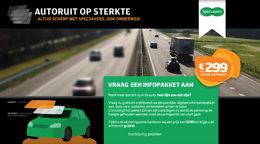
"Always in focus with SpecSavers, even on the go!" The Netherlands branch of SpecSavers (a chain that sells glasses and eyecare services) announced a new product:
prescription windshields. "How great would it be to drive without glasses?" their website asked. Created in collaboration with the Faculty of Product Development at the University of London, the new windshields came in any desired prescription strength.
And for a limited time they were offering an online special. Buy a prescription windshield for €299 and get the rear window free!
More…
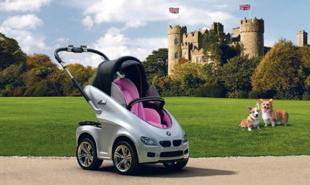
BMW UK debuted the limited edition "Postnatal Royal Auto Mobile," aka P.R.A.M., inspired by the royal baby due in the summer. The infant carrier featured "air con, reclining seat, ambient interior lighting and paparazzi-proof hood as standard." It was available in either Royal Blue or Princess Pink.
More…
Inspired by the reputation of Canadians for politeness and civility, Honda Canada announced a "revolutionary innovation in vehicular communication" that would be available for all models of its cars: the "polite horn." Instead of honking, it made a throat-clearing sound. The company noted, "the polite horn allows drivers to cease causing a ruckus on the road and instead assert themselves passive aggressively, as is appropriate."
More…