BMW began running spoof April Fool's Day adverts in the early 1980s, giving it one of the longest traditions of April Foolery of any corporation. Most of the ads have appeared in UK newspapers and have been created by the agency WCRS. However, BMW Canada also occasionally joins in the fun. (I'm not aware of any April Fool ads run by BMW in the US.)
BMW's marketing department has said that the April Fool ads are "designed to teeter on the verge of credibility," and often focus on a new and revolutionary piece of technology from BMW, but "push the idea just beyond the plausible." WCRS has also explained that it uses the April Fool ads to "puncture pomposity, and create a feeling of belonging to the 'BMW club' of those who enjoy the joke."
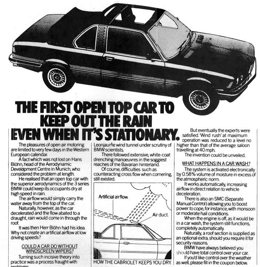
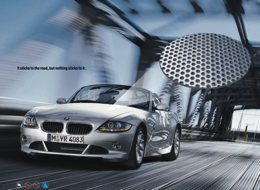
BMW revealed that one of its engineers, Herr Blöhn, had developed a sunroof that could be kept open even in the rain, thanks to jets of air that blasted the water away from the top of the car. The system worked completely automatically, even in a car wash.
Those seeking more information were directed to query "Miss April Wurst" in the BMW marketing department.
More…
BMW announced that its Chief development engineer, Herr Brehn, had come up with a solution for the "irksome chore" of maintaining correct tire pressure: dashboard tire pressure control:
"Herr Brehn perfected a revolving seal, kept airtight by an ingenious contra-flow of air under very high pressure...
Touch a button on the console and a digital display gives pressure... A compressor feeds air into storage units. It then travels to the wheel centre via the revolving seal and through to the tyre. Excess pressure is merely vented into the contra-flow system."
More…
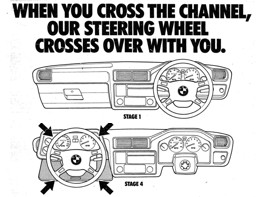
BMW announced that its engineer Aap Rilfühl had figured out a way to allow drivers to switch the position of their steering wheel, so that British drivers could move the wheel whenever they crossed the channel from Britain to France:
By incorporating a second-unit steering wheel socket and instrument panel into a conventional glove compartment, Dr. Rilfühl was able to provide the basis for a secondary driving position.
More…
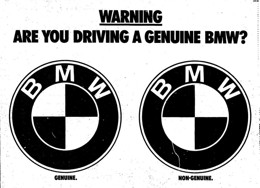
BMW ran an ad in the
London Times warning that a Far East company specializing in "reproduction cars" was selling fake BMWs in the UK. The company offered tips for drivers to determine if their BMW was real or a forgery, such as checking the roundel to make sure it matched the "genuine" symbol.
More…
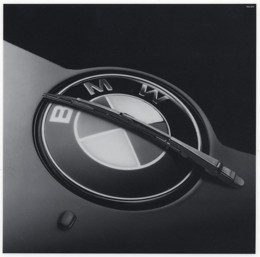
BMW announced a new technological innovation that would be incorporated into future versions of its cars—the badgewash system. No longer would BMW drivers have to endure dirt on their enamel bonnet badge:
"A tiny sensor mounted in the wiper arm measures the light reflected back from the white sections of the BMW badge… Even if a film of dirt cuts out as little as 5% of that light, the sensor will detect it and start the wiper."
More…
BMW unveiled a "significant advance in anti-theft technology" — Driver's Weight Sensors:
"DWS stands for Driver's Weight Sensor. A unique system that compares the driver's weight with a pre-programmed value stored in the sensor's computer memory...
The sensor weight reading is then compared to the programmed weight in the memory, and provided this falls to within ±5%, the car will start normally.
If, however, the figure exceeds these tolerances, then a discreet gong sounds, and the entire ignition system is shut down."
Interested readers were urged to contact Hugh Phelfrett at BMW.
More…
BMW Canada ran an ad in the
Globe and Mail announcing a new addition to its luxury cars: road warmers. Pivoting convex lasers mounted in front of each wheel would melt ice and snow on the road as the car was being driven. Turbo fans would then remove excess moisture from the road. According to BMW's press release, this invention would "virtually eliminate the need to clear your driveway during winter." The advertisement assured readers that road warmers would eventually become standard on all new BMWs, but until then dealers would install them on older models free of charge.
More…
BMW ran an ad in the London
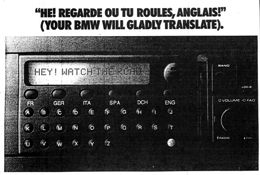
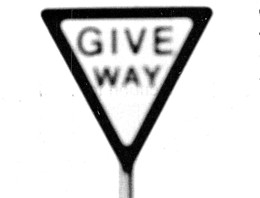
Sunday Times announcing a new "Automatic Translation System" for its cars. This device (developed by senior technician Urbein Waundab) would, at the touch of a button, translate any of the major European languages into English. It would also automatically read and translate every road sign it passed. People were invited to contact "Huw Felvret" at BMW Information Service for more details.
The ad fooled a
New Scientist writer who expressed concern (in that magazine's Apr 21 issue) that on-the-spot translations of insults hurled by French drivers would "enrage the normally placid and polite English driver."
More…
A commercial for BMW aired on British TV promoting a revolutionary new technology, "anti-track control," that enabled the removal of tire tracks from the ground. The ad explained that the technology had been developed by East German military authorities, but it could now be used by surreptitious lovers seeking to conceal their tracks from suspicious partners. The spoof commercial was created for BMW by ad agency WCRS. The footage of disappearing tire tracks was created by taking a previous BMW commercial and playing it backwards.
More…
BMW revealed that it had developed a new "Toot and Calm Horn" (T.C.H.) system, which made a noise that actually calmed other drivers on the road rather than aggravating them, thereby lessening the risk of road rage. The name "Toot and Calm Horn" was styled after Tutankhamen.
This April Fool ad has been fairly widely reported, but I don't know where or when it ran. The earliest report of it I've found dates to 2006. I'm guessing the ad may have run in the 1990s.
More…
BMW announced that certain models of their cars would be fitted with "Optiglass" — a new optical technology that eliminated the need for drivers to wear glasses:
"80,000 transparent threads of silicon are coated onto a Polyvinylbhytral layer (PVB in English) to conduct a charge throughout the focal area of the screen — in much the same way as demisting systems work.
By varying the temperature of the PVB with a simple flick of the dashboard-mounted switch, the refractive index of the glass changes, creating a lens to suit the requirements of all drivers."
More…
BMW announced that it would be adding a new feature to its entire line of cars: an Insect Deflector Screen (or IDS for short), designed to keep windscreens bug free. The IDS, developed by Munich scientist Dr. Jurgen Afalfurit, consisted of a clear rubber coating applied to the windscreen. The coating itself was invisible to the eye, but it caused bugs to literally bounce off the window, "even at high speeds."
Drivers were invited to find out more about IDS by filling out a coupon and checking one of the following options: "I find flies get stuck to my windscreen -- Hardly ever; Sometimes; Far too Often."
More…
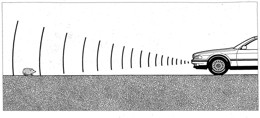
BMW announced a new feature for its cars — WAIL, which stood for "Wildlife Acoustic Information Link." It was a device designed to prevent animals from becoming roadkill by emitting high-pitched soundwaves (inaudible to human ears, but audible to animals) that sent critters scurrying out of the way:
"This operates on the same ultrasonic echo-sounding principle as BMW's Park Distance Control System. Sonic waves are emitted from the front bumper producing a warning call which alerts stray animals to the approaching car. This then encourages them to jump in the nearest hedgerow."
More…
BMW unveiled new "Klimatarbeiter" technology, that could create a range of air conditioning ambiences inside of a car, including "Bavarian Mountain Medley," "New England Fall," "Bessarabian Breeze," or "English Summer." The technology was the brainchild of Dr. Heidi Luftkopf of BMW's Stenchnicht research facility in the Bavarian Mountains.
More…
BMW announced the limited availability of a porcelain statuette of the BMW Z8, created by the "legendary Prussian ceramicist" Loof Lirpa. The actual size of the statuette, a note at the bottom of the ad revealed, was 15ft x 5ft.
[Note: I don't know when or where this ad ran. The BMW Z8 was produced between 1999 and 2003, so presumably this ad ran at some point in that time period.]
More…
BMW Canada announced that its engineers had developed a system that used "microscopic blowholes" in the surface of the car, blowing away "dust, bugs, water and everything else," and thereby keeping the car constantly clean. BMW owners would never have to wash their car again!
[This was one of four April Fool ads run by BMW Canada in 2004.]
More…
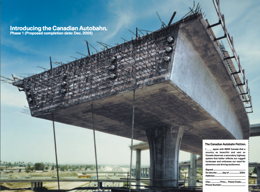
BMW Canada ran an ad urging Canadians to petition their local Member of Parliament to support the creation of a Canadian Autobahn. This roadway would be an "auxiliary highway system that links the Atlantic and Pacific oceans in a manner that benefits high-performance automobiles." BMW Canada revealed that it had already surveyed the country to determine where such an Autobahn might best be placed.
[This was one of four April Fool ads run by BMW Canada in 2004.]
More…
BMW ran an ad in the
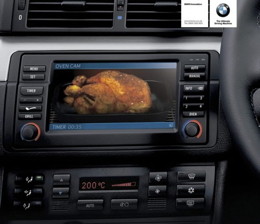
Guardian unveiling its new Satellite Hypersensitive Electromagnetic Foodration (SHEF) Technology, which allowed drivers to cook their dinners from their car as they drove home from work. All the dials for the home oven were built into the dashboard of the car and communicated wirelessly with the actual oven at home. Drivers could monitor the progress of their meal via a built-in oven-cam. The ad directed readers to a website that offered recipes such as "chicken a la M42."
More…
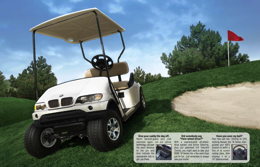
BMW Canada the immediate availability of a BMW 18 Series Golf Cart, featuring "fore-wheel drive," uDrive technology that advised on golf club selection, and a GPS ball-tracking feature that displayed your ball's location on a plasma screen.
[This was one of four April Fool ads run by BMW Canada in 2004.]
More…
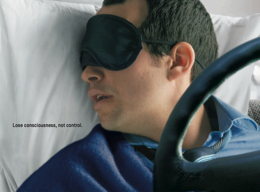
BMW Canada boasted of the new "Retina-evaluating sensory technology" (R.E.S.T.) technology available as a feature in its new cars. This system scanned the eyes of the driver to detect sleep. When detected, the system took full control of the car, allowing the driver to nap peacefully. "Lose consciousness, not control," the ad declared.
[This was one of four April Fool ads run by BMW Canada in 2004.]
More…
BMW warned that by the end of 2007 right-hand drive cars would be banned throughout mainland Europe. In response, their engineers had developed "hands-free steering" that used "a combination of sensors and VAT (Voice Activated Technology)" in order to do away with the steering wheel. "All the dials and controls are mounted in the centre of the dash on a pivoting section which can be angled towards either of the front seats..."
However, it cautioned:
"Early prototypes were prone to sudden U-turns if the driver swung round to shout at the children in the back."
More…
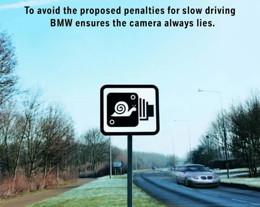
BMW warned that "Slow Cameras" would soon be installed on British roads to photograph drivers going more than 20 mph below the speed limit. In response, BMW engineers had developed "ZIP" (Zoom Impression Pixels):
ZIP is a pixel-based coating that covers the entire exterior of the car. If you are travelling below the speed limit in range of a Slow Camera, sensors around the car detect the camera and the pixels immediately become blurred. This gives the impression of higher velocity and the Slow Camera is fooled into thinking the car is travelling at the correct speed.
More…
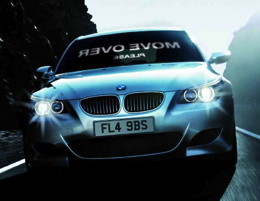
BMW unveiled new technology that allowed drivers to communicate messages via their windscreens:
The system uses Reactive User Sound Electronic (RUSE) particles which are embedded in the windscreen. All the driver has to do is say what's on their mind and the RUSE particles react to their voice to translate their words into an instant message. It enables BMW drivers to communicate advice, warnings, helpful driving tips and salutations to other road users without even lifting a finger.
More…
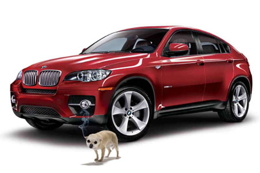
BMW unveiled Canine Repellent Alloy Protection:
The brainchild of Dr. Hans Zoff, head of automotive security, it prevents any dog from relieving itself on the car by administering an immediate, and relatively painfree, electric shock. But the real surprise is that the 220 volts required for this, come courtesy of our brake energy regeneration system. This converts energy created under braking into an electrical charge known as Rim Impulse Power (R.I.P.) and stores it ready for the next encounter.
More…
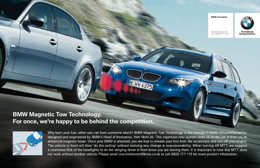
BMW unveiled "Magnetic Tow Technology."
"The unique system, developed in conjunction with NASA, works via a discreet unit located in the front valance that projects an enhanced magnetic beam 20 metres in front of the BMW. Once a suitable target car is located and the BMW is magnetically locked on behind it, the driver is then able to take his foot off the accelerator, turn off the engine and let the car in front do all the work. The towing car will not notice any change in manoeuvrability."
More…
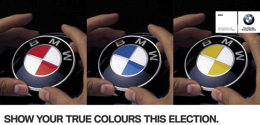
BMW revealed that, in the spirit of the upcoming UK elections, it had created a way for BMW owners to display their political leanings by changing the color of their hood roundel to match the color of their favorite political party. The "Political Roundel Attachment Tag" (PRAT) would be available in the colors of all major UK parties.
Should the car owner decide to switch political allegiances, the roundel tag could be replaced in a matter of seconds.
More…
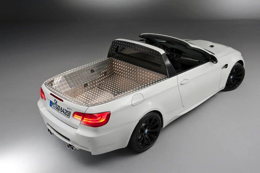
BMW unveiled a pickup-truck version of its M3 sportscar at a Munich auto show. It boasted that it was, by far, the "sportiest" as well as fastest pickup truck available, and that it would "fire the imaginations of all motorists with a deep appreciation of top performance matched by a keen practical bent."
The M3 pickup was actually quite real, functional, and street legal. However, it was a one-off and was not heading for mass production. BMW revealed that it would use the car as a transport vehicle in its workshops.
More…
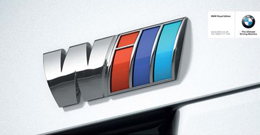
BMW ran ads in UK newspapers announcing that in honor of the forthcoming wedding of Prince William and Kate Middleton, a special "Royal Edition" of the BMW M3 Couple would be available for one month. It would come in three colors: Regal Red, Bridal White and Imperial Blue.
It would also be adorned with a commemorative "Will" emblem.
More…
BMW debuted a "driverless Running Coach" feature that transformed the car into a fitness coach. Cars fitted with this technology would be able to drive themselves, while following behind the jogging owner.
Exterior speakers would play encouraging words to keep the runner motivated, while the "Lock Out Logistics" feature would prevent the jogger from getting into the car until he had completed his full run.
More…
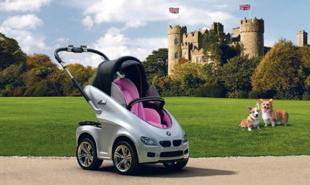
BMW UK debuted the limited edition "Postnatal Royal Auto Mobile," aka P.R.A.M., inspired by the royal baby due in the summer. The infant carrier featured "air con, reclining seat, ambient interior lighting and paparazzi-proof hood as standard." It was available in either Royal Blue or Princess Pink.
More…
BMW UK announced that new models in its line of electric cars, the BMW i, would feature lunar paint as an option. A press release explained: "BMW Lunar Paint uses revolutionary photovoltaic technology to passively recharge your battery in the hours of darkness, extending your electric range even further."
More…