Hoaxes by shows broadcast on America's National Public Radio
NPR's
All Things Considered ran a segment about the threat of extinction facing the Vince Lombardi Fondue Springs, the "last surviving spring of natural fondue cheese in the United States," located in the fondue country of northern Wisconsin.
For years the fondue springs had been a "point of pilgrimage for cheese communicants." But now, the Cheese Watch Society warned, the Fondue Pocket was reducing. The society recommended "a highly trained force of cheese rangers to control visitors to the fondue pocket using sniffer dogs." If steps weren't taken, the society warned, the cheese would soon be gone.
More…
NPR's
All Things Considered revealed that the Reagan administration had decided to sell the state of Arizona to Canada. Money from the sale would help reduce the national debt, and Canada, for its part, as the Canadian ambassador to the US explained, was eager to acquire a warm-water port "and this was the best we could do."
Former governor of Arizona Bruce Babbitt, who had recently dropped out of the race for the presidency, had been offered the job of running the new province. He had accepted the position, saying it was apparent that Canada had "greater faith in my ability to lead."
More…
Scott Simon reported for NPR's
Weekend Edition about an Iowa company called "Doug Be'net" that sold only descriptions of items, rather than physical items. Customers dialed a toll-free number and chose from 24 monthly selections ranging from under $16 to nearly $40.
Simon reported, "All that exists of the items are those words. Doug Be'net is an inventory of ideas and adjectives rather than products. The company stocks no actual merchandise, and therefore, spends no money on manufacturing, consumer warranties or product maintenance." The company was said to have made $1.5 million in sales the previous year. Its primary market was "the same professionals who rent art movie videos and get gourmet food to go. Consumers with limited time but expansive tastes."
NPR subsequently received numerous calls from listeners interested in contacting the company, including one from a Federal Trade Commission employee who wasn't sure if it was a joke and wanted more information. The president of NPR at the time was Douglas J. Bennet.
More…
NPR's
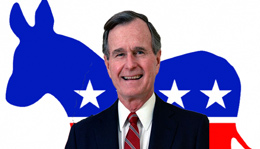
Morning Edition reported the scoop that the Democrats planned to nominate George Herbert Walker Bush as the Democratic candidate for President — even though he would simultaneously be the Republican candidate. Since the Democrats held their convention first, one of them explained, "by the time the Republicans get to him he'll already be ours."
Democrats were viewing the choice pragmatically as "a transition from idealism to realism." Rather than having to suffer under a president of the other party they didn't like, they could endure one of their own party they didn't like.
More…
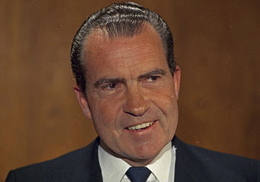
NPR's "Talk of the Nation" reported that former-President Richard Nixon had declared his candidacy for the Republican presidential nomination. Accompanying the announcement were audio clips of Nixon delivering his candidacy speech and declaring "I never did anything wrong, and I won't do it again."
Listeners reacted emotionally to the announcement, flooding NPR with calls expressing shock and outrage. Only during the second half of the program did host John Hockenberry reveal that the announcement was an April Fool's Day joke. Comedian Rich Little had impersonated Nixon's voice.
More…
National Public Radio's
All Things Considered program reported that companies such as Pepsi were sponsoring teenagers to tattoo themselves with corporate logos. In return, the teenagers would receive a lifetime 10% discount on that company's products. Teenagers were said to be responding enthusiastically to the deal.
More…
NPR's
All Things Considered interviewed Reed Summers, winner of a "Mouth Sounds" competition in Belleville, Illinois.
Summers explained that "mouth sounders" use their mouth, tongue, teeth, lips, and vocal chords to create a variety of sounds, such as the sound of an angry cockatoo, a goose, a train, and Bach's Toccata — all of which he demonstrated in the studio.
As the interview with Summers progressed, the sounds he made grew increasingly elaborate and realistic, causing host Robert Siegel eventually to declare, "If I hadn't seen you doing that in front of me just now, I would have assumed that was a recording."
Summers attributed his mouth-sounding skill to the fact that he didn't speak until he reached the age of 10, but instead spent his childhood listening to the sounds around him.
More…
Jacki Lyden, of NPR's
All Things Considered, discussed a new fad among teenage girls:
navel removal. The procedure, called a navelectomy, was being performed in mini malls on both the west and east coasts.
Critics of the procedure pointed to the risk of infection and scarring. But its proponents noted that it made the belly a "blank canvas," which was convenient for getting a tattoo. Also, "the aborigines in South America have it done, so it's totally natural, and it's really safe." One mother was unhappy with her daughter's decision to have the operation because it had removed their connection from the womb.
More…
NPR's
All Things Considered revealed that a California-based company, LunarCorp, had developed a laser powerful enough to project images on to the surface of the moon. It planned to use this to beam advertisements onto the moon, turning the earth's satellite into a giant billboard.
More…
NPR's
All Things Considered reported that the Bush administration had proposed extending universal health care to pets. The measure was designed to assist all animals, including "Your dog, your cat, your iguana, your great komodo dragon."
However, the proposal was meeting with opposition. James Cardigan, spokesman for the group People Are People Too, feared the government could get tangled in massive legal liability by letting nature simply take its course. For example, "what if a hamster covered by federal health care is eaten by a snake also covered by the federal government?"
Universal pet health care was estimated to cost $345-trillion.
More…
NPR's
All Things Considered ran a segment about the efforts by preservationists to transfer audio recordings to a durable medium that would last far into the future. The medium they had decided upon was shellac — the material Edison had used when he first invented recording technology back in the nineteenth century. Archivists had identified this as "the one rock-solid format... that works every time."
Works such as Vanilla Ice's debut CD were being painstakingly transferred onto shellac. The report concluded: "If funding levels can be maintained, experts estimate the archiving project can catch up with recordings made before 2003 by April 1, 2089."
More…
NPR's
All Things Considered reported that the U.S. Post Office was introducing a new
portable zip codes program that would allow individuals to take their zip code with them when they moved. The program was inspired by a recent FCC ruling that allowed people to retain the same phone number wherever they moved or whatever service they switched to.
Supporters of the program noted, "A modern, mobile society… can no longer afford to remain grounded in locale-specific zip codes… a zip code is a badge of honor, an emblem symbolizing a citizen's place in the demographic, rather than geographic, landscape."
More…
NPR also ran a story about the
growing use of performance-enhancing drugs (steroids) in the world of music. It stated that: "Something is happening in the world of music. Musicians are playing faster, louder, and stronger than they ever have before… Rumors have been circulating for some time that just like in the world of sports performance enhancing drugs may be the cause."
More…
NPR's
All Things Considered ran a segment on
a drop in maple syrup consumption, triggered by the low-carb craze, which supposedly was causing a serious problem for New England's maple-tree industry: exploding maple trees. The announcer reported: "An untapped tree is a time bomb ready to go off… The trees explode like gushers, causing injuries and sometimes death. If untended, quiet stands of Nature's sweeteners can turn into spindly demons of destruction. The Vermont Health Board reports 87 fatalities, 140 maimings, and a dozen decapitations, caused by sap-build-up explosions this year."
More…
National Public Radio's Weekend Edition Sunday
reported that New York City Democratic councilman David Yassky had called for a ban on obnoxious ring tones. The councilman claimed that objectionable ring tones were costing the economy upwards of $1.2 billion and were the cause of numerous fights induced by "ring-tone rage." As of April 1, 2008, NPR reported, cell phone users would be restricted to four city-approved ring tones.
More…
The hosts of NPR's
All Things Considered read
a sample of listeners' comments about a previously-aired story involving a plan to use farm-raised whales as an alternative source of energy. The whales were being raised on a farm in Bellesville, Illinois in "hundreds of acres of wide pools as far as the eye can see."
One listener remarked that there was nothing remarkable about such a farm since "Cetaceaculture, or whale farming, is already a big business in Europe."
In reality, NPR had never aired such a story, nor had it received any of the comments that were read. But for a while after the segment, "farm-raised whales" was the top search on Google.
More…
Melissa Block reported for NPR's
All Things Considered about the
"slow internet movement" which was rapidly growing in popularity in "hipster enclaves" such as Portland, Oregon and Ottumwa, Iowa. Devotees of this movement preferred to browse the internet at slow speeds, and so they purposefully chose dial-up connections over faster broadband ones.
Dr. Uri Langsam noted that slow internet could have physiological benefits since studies revealed that as the connection speed slowed down the alpha waves of the user became similar to someone who was meditating: "The thinking improves. The complexion improves. It's just amazing what it will do."
More…
NPR's Marketplace reported that advertisers were experimenting with genetically engineering food so that it would display advertisements. For instance, it was possible to engineer burger patties so that as they cooked an image of "Mr. Pickle" appeared on the burger. At 160 degrees Fahrenheit, Mr.Pickle would even start to wave.
One ice-cream maker had also created cones with coupons inside the ice cream. The secret coupon code was revealed after you took a bite of the ice cream.
But consumers seemed wary of these food advertisements. One shopper said, "20 percent [off] isn't worth having to stare at ads at dinner."
More…
Jen Sands-Windsor reported for NPR's
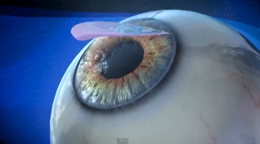
Morning Edition about a new surgical procedure that made people's eyes "act like 3D glasses," eliminating the need to wear special glasses when watching 3D movies or TV.
One recipient of the surgery raved, "Seeing 'Gnomeo & Juliet' without those horrible glasses was life-changing."
Unfortunately, a side-effect of the surgery was blurred vision when not looking at a 3D screen, but the developer of the procedure was working on corrective lenses "that will allow our patients to see real life normally."
More…
NPR's Weekend Edition revealed the
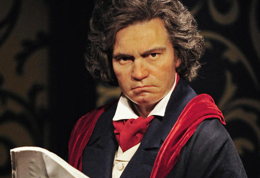
discovery of a 10th symphony written by Ludwig van Beethoven. It had been found by Professor of Musicology Friedrich von und Zum Hagen while doing research in the library of New York's Masonic Hall. It was hidden inside a folder labeled "Johann Nepomuk Maelzl" — the name of a 19th-century inventor of a transcribing piano that produced a printed version of any piece of music played on it. Zum Hagen speculated that Maelzl asked Beethoven to try out this piano "since the composer was very enthusiastic about technical advances." When Beethoven did so, the machine transcribed the 10th symphony. Maelzl then "absconded to America with the manuscript."
More…
NPR News tweeted that "Tweets Will Shrink To 133 Characters: The seven-character change is expected to save Twitter $1.4 billion this year."
The tweet provoked numerous replies, including "Good luck on expressing anything" and "Not enough characters to tweet my outrage."
A link directed Twitterers to the
NPR blog where it was revealed that the headline was "just a joke." Although NPR admitted, "The productivity of the newsroom took a hit to come up with that fake headline."
Robert Siegel, of NPR's
All Things Considered, reported on an effort to
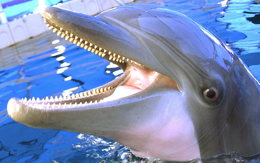
record the experiences of U.S. Navy dolphins in their own words. The dolphins were aquatic veterans housed in a home for retired dolphins in landlocked Belleville, Illinois. Graduate students prompted the dolphins to speak by feeding them fish and then recorded their chatter with underwater microphones.
However, project curator Cory Storr admitted, "We have no (bleep) idea what these dolphins are saying. They could just be shooting the (bleep) or singing or talking smack about seals. We have no idea."
More…
NPR movie critic Bob Mondello reported for
All Things Considered on a remake of the 1941 movie classic
Citizen Kane. The new version, titled
Citizen Kane 3-D, was directed by and starred Keanu Reeves, and added a martial-arts subplot to the tale of a wealthy media tycoon who dies friendless, haunted by his childhood. Mondello noted, "Perhaps it's best to think of this Kane as a reinterpretation, not a remake. Citizen Keanu, if you will."
More…
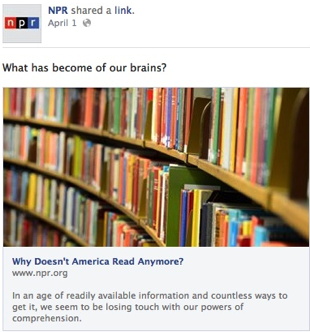
On its Facebook page, NPR News shared a link to an article with the provocative title, "Why Doesn't America Read Anymore?" The link generated hundreds of comments. Some agreed with the premise. Others disagreed. But what these responses shared in common was that the people who posted them apparently hadn't clicked through to look at the article itself. If they had, they would have discovered an announcement that read, "We sometimes get the sense that some people are commenting on NPR stories that they haven't actually read. If you are reading this, please like this post and do not comment on it. Then let's see what people have to say about this 'story.'"
More…